
🔥 FLEXIBLE & SECURE PAYMENTS — USDT • USDC • BTC • ETH • SOL • TRON (TRC20) • BINANCE PAY • KAST & MORE
IPTV Reseller Program in 2027: Credits, Support and Profit Planning
 plustv
•
10 min read
The idea of running an IPTV reseller business can sound appealing: a panel, some credits, and customers who renew. But the work doesn’t end when a subscription is activated. Customers need clear instructions, reliable service, and someone who can explain a billing issue without disappearing. If you’re considering becoming a reseller, start with the numbers and the supplier’s rights—not the promise of effortless income. In this guide, you’ll learn how to assess a supplier, understand reseller credits, calculate sustainable margins and build support processes that encourage long-term customer trust.

What is an IPTV reseller?
An IPTV reseller sells access to a supplier’s streaming service to end customers. The reseller may handle customer onboarding, billing, basic technical support, and renewals. Before starting, verify the supplier has the necessary rights to distribute the content in every target market. A reseller panel is an administrative tool, not evidence of content licensing.
Understand credits and activation
A credit system typically allocates a balance that can be used to create or renew subscriptions. Suppliers differ in how many credits each duration or connection consumes. Ask for a written rate card, expiry rules, credit reversibility, and whether unused credits can be transferred. Build a small spreadsheet before committing capital.
Calculate real margins
Revenue is not profit. Subtract the wholesale credit cost, payment fees, refunds, advertising, support time, chargebacks, taxes, and any software costs. For example, selling a subscription for $50 does not yield a $50 margin if the underlying access costs $25 and payment processing and support add another $8. Model optimistic, base, and conservative scenarios.

Test supplier quality
Use a legitimate trial to test channel availability, picture quality, device compatibility, and service response during busy hours. Ask how outages are reported and resolved. A large channel count or an attractive dashboard cannot replace consistent playback and transparent service terms.
Define your support promise
Decide which support requests you will handle and which need supplier escalation. Document installation steps for common devices, typical error messages, and a procedure for billing disputes. Do not advertise instant human support at all hours unless you can deliver it.
Build a responsible onboarding flow
Give customers a written order confirmation, service duration, authorized content scope, supported devices, account activation instructions, refund policy, and support contact. Avoid asking customers for unrelated passwords. Keep customer information to the minimum necessary and protect access to your reseller panel.
Avoid overselling simultaneous connections
A supplier may distinguish active devices from simultaneous streams. Clarify the exact limits before advertising two or more screens. A mismatch between your marketing and the supplier’s policy can create complaints, refunds, and account restrictions.
Compare payment options
Cards may offer convenience but also bring chargebacks and processing fees. Cryptocurrency transfers may have different risks and are often irreversible. Maintain clear invoices and accurate records regardless of the method. Do not represent crypto as inherently anonymous or free of compliance obligations.
Plan a small pilot
Start with a modest number of customers and track activation success, support tickets, renewals, churn, refunds, and average response time. Collect feedback on navigation and reliability. Use those observations to refine your documentation before spending heavily on advertising.
Market with evidence
Explain compatible devices, the trial process, support availability, and pricing clearly. Avoid unsupported claims such as zero buffering or guaranteed access to every premium event. Use genuine testimonials with customer permission and never invent ratings or reviews.
Track customer lifetime value
A customer’s value depends on repeat purchases minus servicing and acquisition costs. If a campaign costs $100 and produces four paying customers, the initial acquisition cost is $25 each. Compare that figure with realistic gross margin and expected renewals rather than focusing on clicks alone.
Legal and operational checklist
Before launching, confirm supplier authorization, local consumer law, taxes, privacy practices, payment terms, content rights, refund handling, support escalation, and secure access management. Reseller businesses depend on repeat trust more than an impressive panel screenshot.
FAQ
How many credits should I buy? Only what your verified demand and cash flow justify. Can I sell worldwide? Not unless the supplier’s content rights and your business obligations allow it. Is a reseller panel enough? No; you also need legitimate supply, support processes, and accurate financial records.
IPTV reseller program: what a professional offer should include
A credible IPTV reseller program is more than a login to a dashboard. Before comparing prices, ask what the supplier actually provides: account provisioning, renewal controls, transparent credit accounting, onboarding materials, outage notices and a clear support escalation route. The best partnership for your business is one whose promises you can explain accurately to customers. Request a demonstration of the reseller panel and ask to see how an activation, extension and cancellation are recorded. If the supplier says that a feature exists, test it with a sample account. A polished sales presentation is useful, but a working operational process is worth much more.
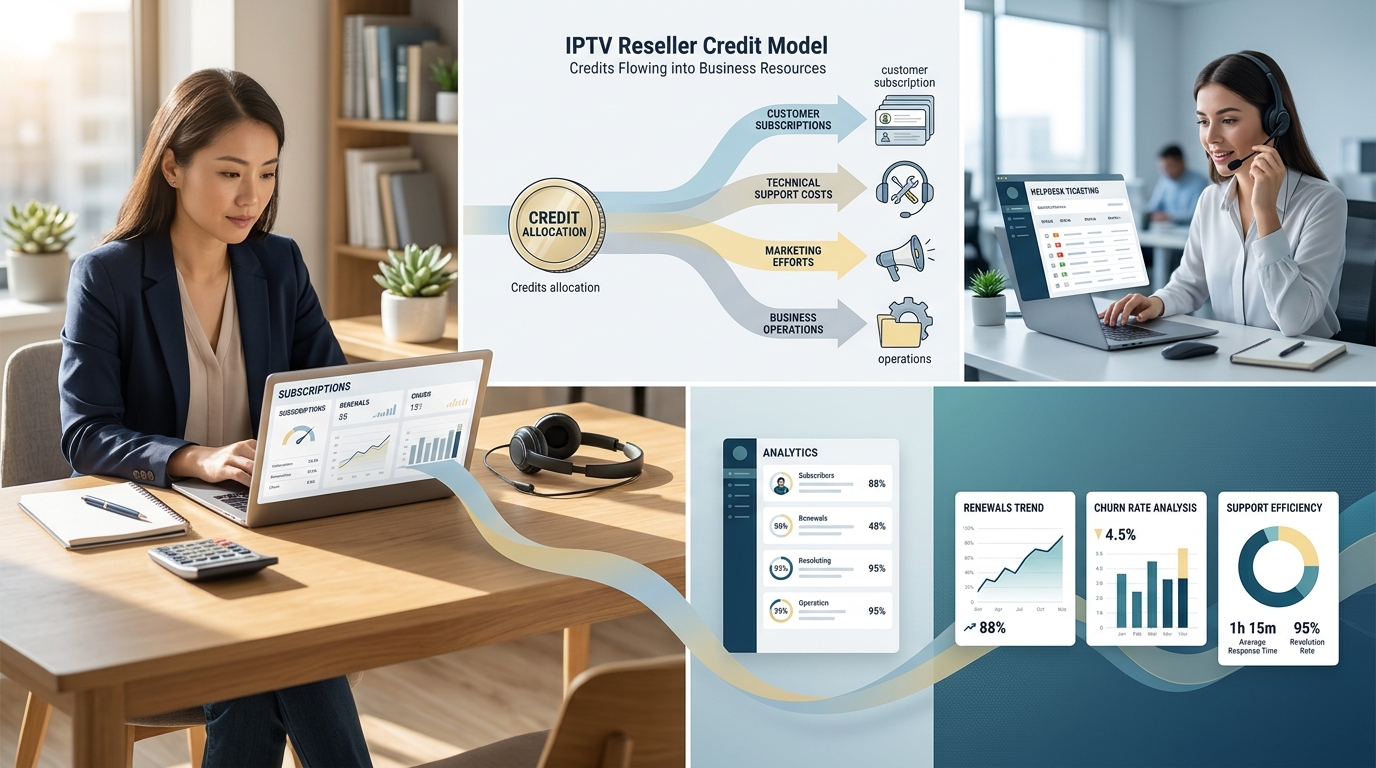
A practical example of reseller credit economics
Imagine a supplier charges $200 for a starter panel and credit bundle. That figure alone does not tell you the cost of one customer subscription: you need to know the number of usable credits, how many credits each plan consumes and whether there are additional monthly panel fees. Suppose, purely as an illustration, that a bundle contains 50 credits and a one-year activation uses five credits. The theoretical inventory is ten annual activations, with an initial allocation cost of $20 per activation before fees and support. If a different duration consumes more credits, the calculation changes. Do not treat this example as a Plus TV rate card. Obtain the actual schedule in writing before setting retail prices.
Reseller panel features to test before you pay
Open the panel and work through a typical customer journey. Can you create an account without exposing other customers’ details? Can you see the subscription start and expiry dates? Does a renewal add time correctly, and can you find a transaction history when someone disputes an expiry? Check whether the panel supports multiple service profiles and whether those profiles have different availability or connection rules. Ask about two-factor authentication, role-based access and backup access if your main administrator is unavailable. A useful dashboard should reduce errors, not simply look impressive in screenshots.
How to price without making unrealistic promises
Start with your true unit cost, then add a reasonable allowance for customer support, payment processing, refunds and acquisition. If an annual subscription costs you $20 in credits, payment fees are $2, average support costs are $5 and marketing costs $8, your estimated total cost is $35. A retail price of $50 would leave $15 before tax and unexpected expenses. That is a planning example, not a guaranteed result. Stress-test it: what happens if advertising costs double, a customer requests a refund or an activation needs extra support? Pricing that works only when everything goes perfectly is not sustainable.

Why support can be your strongest differentiator
Customers remember the person who helps them configure a television more than the number printed on a promotional banner. Create a short onboarding message that asks for the device model and preferred app, then sends the relevant instructions. Maintain a small troubleshooting library for common issues such as incorrect credentials, missing VOD categories, app activation fees and temporary playback errors. When a problem is beyond your control, explain what you know and what you are checking rather than promising an instant fix. If you advertise 24/7 VIP support, make sure the response arrangements actually support that claim.
A sensible 30-day launch plan
During week one, verify the supplier’s authorization, contract terms, panel controls and sample activations. In week two, create customer-facing instructions, a clear pricing page and a simple support intake form. In week three, run a small pilot with consenting customers, record their setup questions and check how the service performs at different times. In week four, review conversion rate, support burden, renewals, payment fees and unresolved complaints. Expand only when the evidence supports it. This measured approach may feel slower than buying a large bundle immediately, but it protects cash flow and exposes operational gaps early.

Key performance indicators for an IPTV reseller
Track a few numbers consistently rather than collecting dozens of vanity metrics. Activation success rate tells you how often customers can start using the service without a second intervention. First-response time measures how quickly someone acknowledges a request. Resolution time reveals whether support actually solves problems. Refund rate and chargeback rate can expose misleading expectations. Renewal rate and churn show whether customers see enough value to stay. Finally, gross margin per subscription helps you understand whether growth is financially healthy. Review these figures monthly and annotate unusual outages or campaigns so the trends make sense.
Payment methods: cards and cryptocurrency
Different customers prefer different ways to pay. Cards can feel familiar and may provide dispute procedures, but merchants must account for processing costs and chargeback rules. USDT or another supported cryptocurrency can be convenient for cross-border customers, yet blockchain transfers are often irreversible and network selection matters. Never pressure a customer into a method they do not understand. Provide a clear invoice, confirm the network and amount before payment, and avoid collecting seed phrases or unrelated banking information. For a legitimate business, trust comes from transparency and responsive support—not from insisting on one payment rail.
Building a reseller website that earns trust
A professional landing page should answer the questions visitors have before they contact you. Explain what the service includes, which devices are compatible, what simultaneous connections mean, how installation works, which payment methods are accepted and how support is reached. Make the refund and privacy policies easy to find. Add genuine customer feedback only with permission, and avoid fabricated star ratings. Use clear headings, short paragraphs and helpful screenshots where appropriate. A site that makes practical information easy to find often converts more qualified inquiries than one dominated by exaggerated claims.
Content marketing and SEO for reseller enquiries
Search visitors frequently arrive with a specific problem: they want to understand reseller credits, compare panel options or learn how support works. Write articles that solve those questions before making a sales pitch. Use the focus phrase IPTV reseller program naturally in the introduction, a useful heading and the SEO metadata. Link readers to relevant installation, payment and reseller information on your own site. Avoid stuffing the same phrase into every sentence. Search optimization helps a page get discovered, but credible explanations and a clear next step are what make the visit worthwhile.
Questions to ask a prospective supplier
Before you commit, ask: Which territories and content are you authorized to serve? What exactly does each credit buy? Are panel fees recurring? Can I test a sample account on common devices? How are outages communicated? Who handles escalated tickets? What happens to unused credits if the relationship ends? Are refunds or reversals possible, and under what conditions? Can I export my own customer and transaction records securely? A supplier who answers clearly gives you a stronger basis for planning than one who relies only on urgency or a limited-time price.
Conclusion
A sustainable IPTV reseller operation starts with a transparent supplier relationship, a tested product, responsible marketing, and measurable customer service. Treat coaching as operational guidance, not a substitute for licensing verification or financial planning.

Related Articles

November 20, 2026
IPTV in Kosovo, Serbia and North Macedonia: Language and Device Compatibility Guide

November 20, 2026
IPTV in the Balkans: A Regional Viewing Guide for Families and Diaspora

November 20, 2026
IPTV in Albania: Devices, Albanian Language and Setup Guide

November 20, 2026