
🔥 FLEXIBLE & SECURE PAYMENTS — USDT • USDC • BTC • ETH • SOL • TRON (TRC20) • BINANCE PAY • KAST & MORE
IPTV in the Balkans: A Regional Viewing Guide for Families and Diaspora
IPTV in the Balkans compared properly: viewer location, language layers, EPG accuracy, cross-border logins and licensing questions to ask first.
 plustv
•
11 min read
Searching for IPTV in the Balkans usually starts with a phrase like “Balkan channels”, as if the region were one market with one shared line-up. It is not. A family in Zagreb, a student in Sarajevo and a grandmother in Vienna who wants Serbian news all need different languages, different guides and, crucially, different licensing.
This guide helps you compare offers by the things that actually decide whether a service works for your household: where the TV is, which language layers you need, how the programme guide behaves, and what happens when family members share a login across borders. It does not list channels or claim any are available.
Table of Contents
IPTV in the Balkans: regional does not mean interchangeable
The Balkans contains several languages, national broadcasters and licensing territories. A family in one country may be comparing entirely different services from relatives across the border. The right question is not which provider advertises the largest ‘Balkan’ playlist, but which authorized services offer the desired programming for the viewer’s actual location and devices. This guide focuses on those practical differences, including electronic guides, character sets, travel terms and safe installation.
Define the audience before the package
The Balkans is a broad cultural and geographic description, not a single television-rights market. Families may use Albanian, Serbian, Macedonian, Bosnian, Croatian, Bulgarian, Greek or other languages, and their priorities differ. Start with the household’s actual location and preferred programming. Ask each service for a location-specific channel list and documented rights. A single ‘Balkan channels’ category can conceal gaps in national news, regional entertainment or language accessibility. The most useful comparison is between named programs available lawfully in the viewer’s country, not the advertised size of a generic playlist.
Regional EPG and character handling
Regional television guides need to handle accented Latin characters and, for some channels, Cyrillic scripts. Test search, favorites and program-guide descriptions on the actual television. A guide can look complete in a screenshot while displaying the wrong time zone or broken character encoding in practice. For bilingual households, test whether the player remembers subtitle and audio choices between sessions. Families with children should also review content ratings and parental controls, especially where different national broadcasters use different presentation conventions.
Travel and cross-border subscriptions
People living, working or visiting across Balkan borders may encounter changing catalogs. Distribution rights, app-store availability and billing conditions can differ by country even when the language is shared. Ask the provider about temporary travel access and the number of permitted simultaneous devices. A working stream on one side of a border is not proof of authorization on the other. Keep screenshots of the written terms and check broadcaster websites for high-value sports events rather than assuming any bundled list includes them.
‘Balkans’ is a cultural shortcut, not one licensing zone
The regional label covers countries with different languages, media laws, service catalogs and consumer experiences. A list that mixes Croatian, Serbian, Bosnian, Albanian, Macedonian, Greek and other programming may be useful for discovery, but it is not proof that each stream can lawfully be offered in every country. Start from where the viewer lives and which language tracks are required. Then check distributor rights and the relevant national service’s terms. A household in Sarajevo and relatives in Skopje may need different subscription arrangements even if they speak overlapping languages. Avoid advertising a single ‘Balkan package’ as universally available unless it can be documented territory by territory.
Language layers: menus, audio, subtitles and EPG
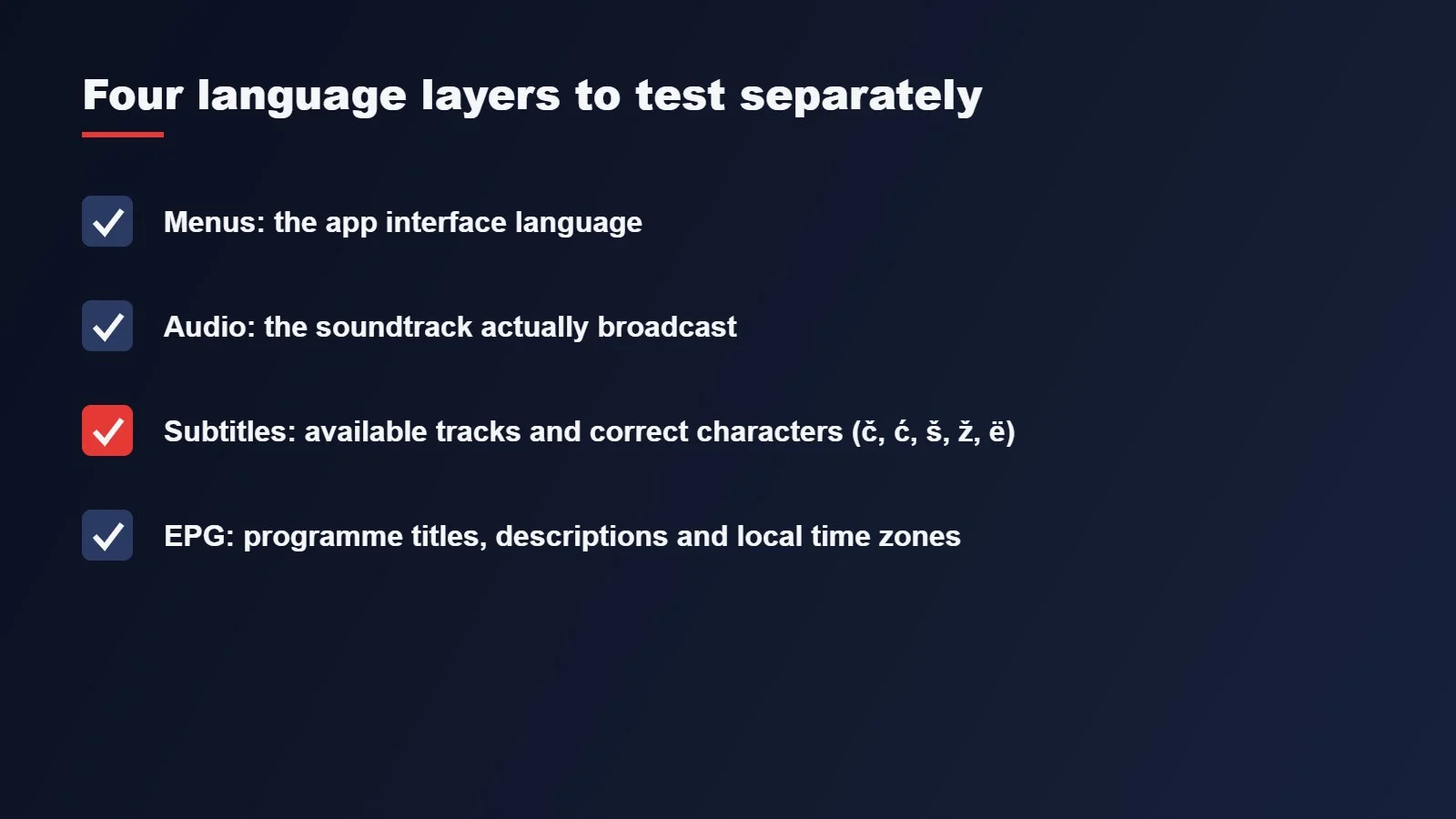
Four separate language layers affect a viewer’s experience. The app menu determines navigation; the audio track determines what can be heard; subtitles help accessibility and translation; and the electronic program guide labels what will be shown. A provider may support one layer but not another. Test the Cyrillic and Latin alphabets where relevant, including names with diacritics, rather than assuming all devices display them correctly.
Save screenshots of misencoded guide entries without exposing account data. If younger family members prefer one language and parents another, check whether favorites and profiles are individual. The size of the library is less important than whether people can locate the programs they intend to watch.
Build a regional comparison by viewer location
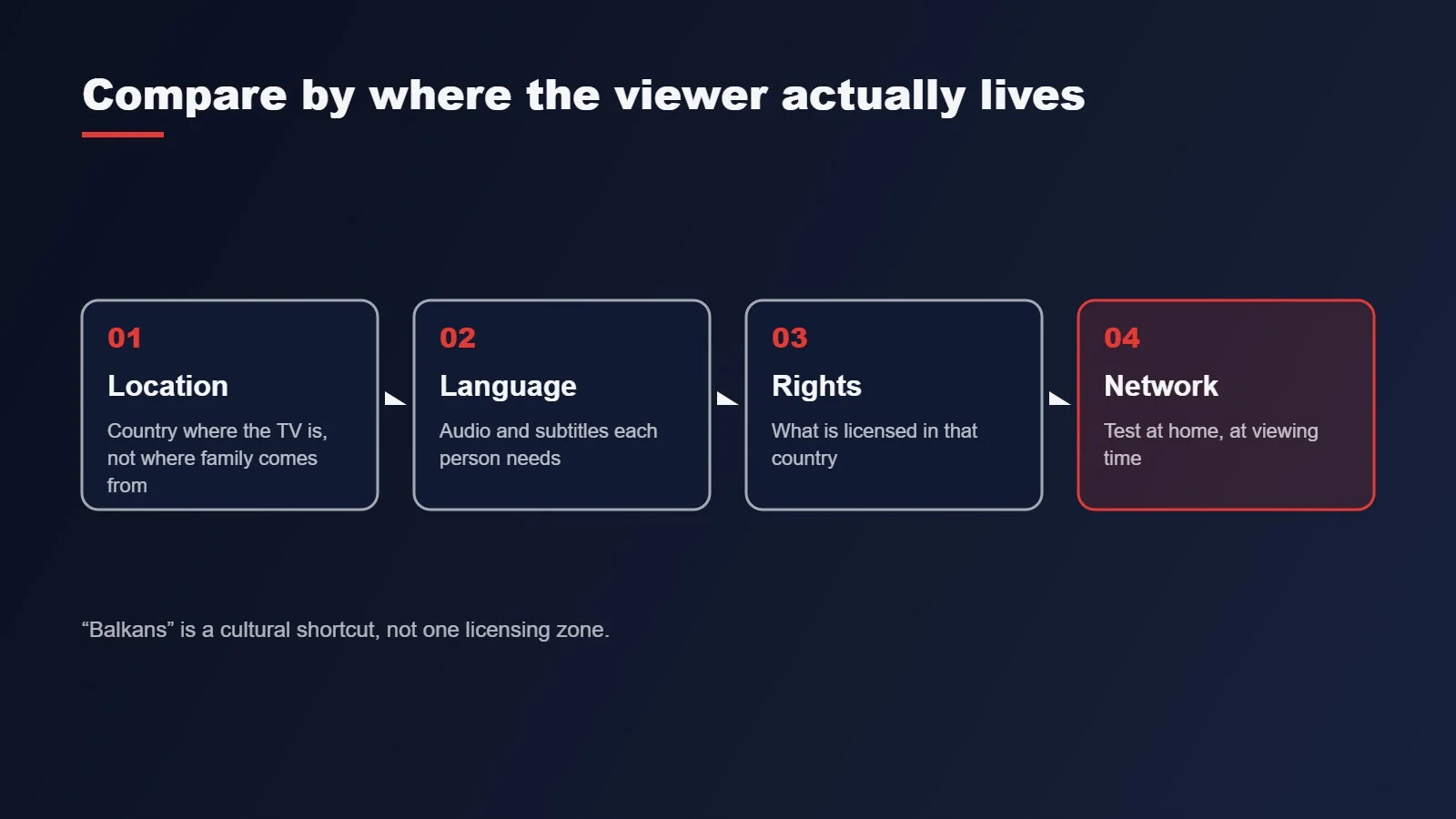
Use a country-by-country worksheet instead of a platform ranking. For each location, record the household broadband type, supported devices, dominant language and official broadcasters or platforms to investigate. Check the latest territorial restrictions on the actual provider site. In countries with EU or EEA membership, specific cross-border portability rules may apply to eligible paid subscriptions during temporary travel, but the regulation is not a universal permission to redistribute channels. Several Balkan countries are outside the EU/EEA, so the rule should not be assumed to cover every border crossing. Distinguish what a law requires from what a particular provider voluntarily allows.
What to test when a family shares one login across borders
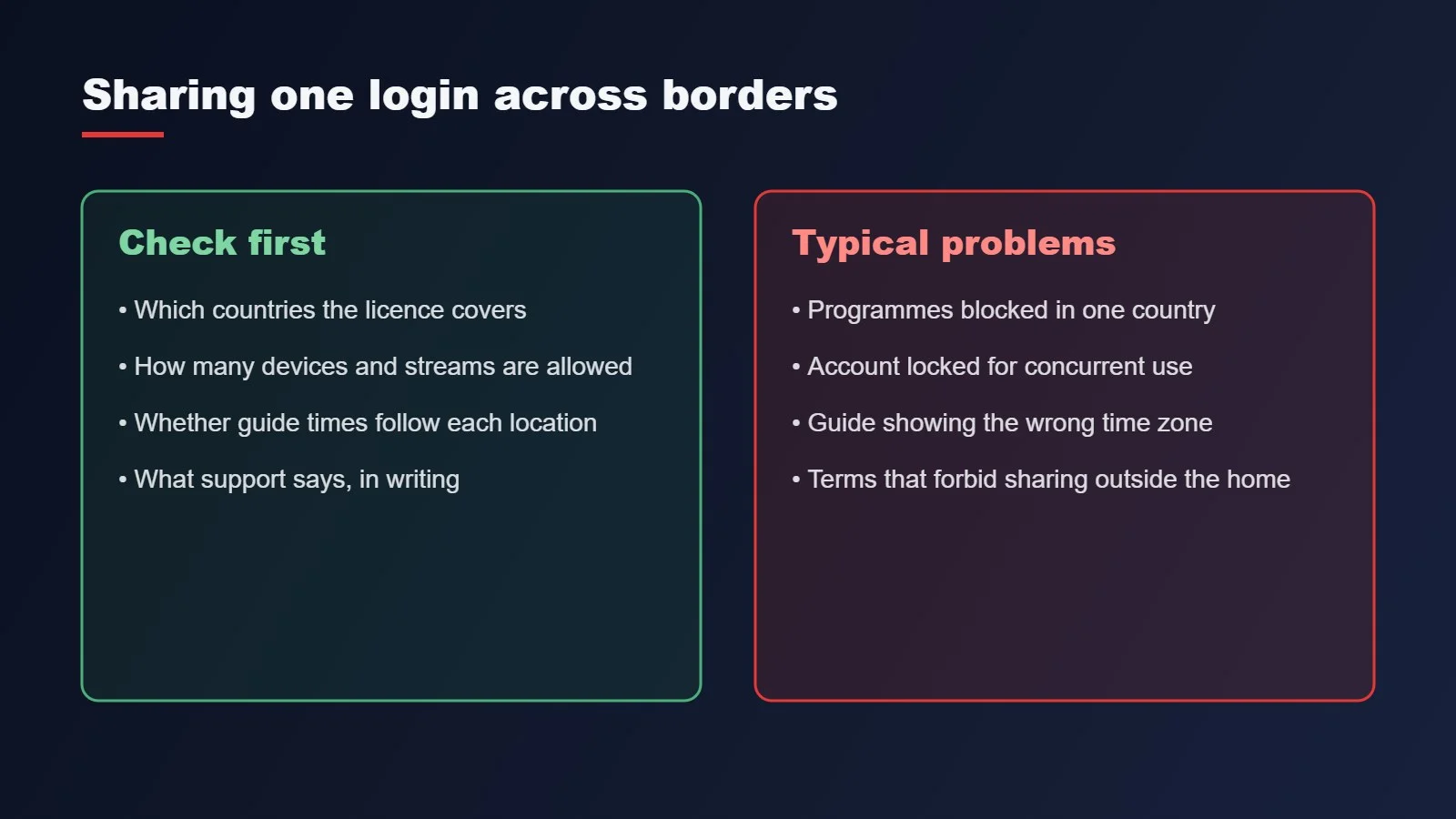
First check whether the terms even permit simultaneous use from different households or countries. Next, determine whether the app offers separate profiles, subtitles and language options for each viewer. If the family splits time between homes, note whether the subscription can legitimately be used while traveling or whether a new local account is needed. Do not disguise different households as one to evade connection limits. Device compatibility can also change: one person’s Android TV player may be unavailable in another person’s smart-TV app store. Treat account permissions, local catalog and hardware as three independent checks. An answer from one successful trial should not be projected to the entire region.
Diagnose guide mismatches before blaming content
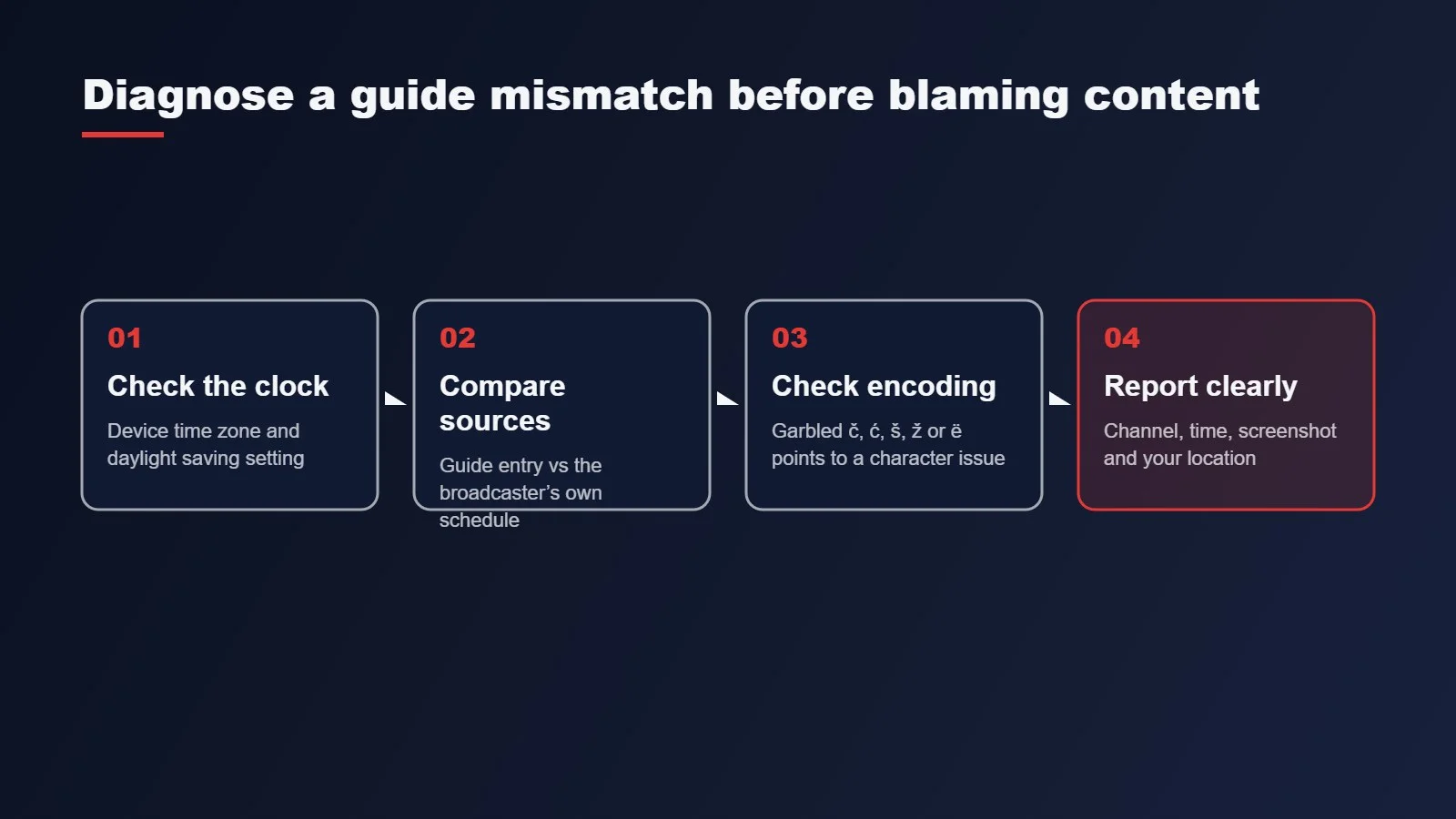
The region spans several scripts and time-zone settings. A channel can be present while the electronic guide displays a title incorrectly or an event at the wrong time. Ask whether the app allows per-source EPG offsets and character handling, and compare a known program with the broadcaster’s official schedule. Do not change the television’s global clock just to patch one guide source. If one channel’s guide fails but others work, report its identifier and local time. If every title is garbled, investigate the player font, encoding and source feed. This problem-solving angle is more useful for multilingual viewers than a lengthy, unverified list of supposedly universal stations.
Connectivity: test at the household, not the country level
A service can work well in an apartment on fiber and poorly on a hotel connection; the difference is not necessarily national infrastructure. Run a baseline test in the viewing room and compare it with Ethernet or a second authorized app. For Serbian households, RATEL provides a NetTest service and broadband quality information; other countries have their own resources. Record whether multiple devices are using the connection and whether a local VPN or Wi-Fi repeater is involved. Do not infer server location from traceroute or make promises about particular providers’ regional peering. Treat connectivity evidence as a diagnostic clue, not a rating for an entire country.
A country-aware decision matrix for IPTV in the Balkans
| Situation | Primary question | Evidence to collect |
|---|---|---|
| Multilingual household | Audio and subtitles per title? | Hands-on language test |
| Cross-border family | Is account sharing permitted? | Terms for territory and concurrency |
| Smart TV owner | Is native app available locally? | Official-store listing |
| Live-sports viewer | Who holds rights at this location? | Authorized broadcaster statement |
| Weak Wi-Fi room | Is wired playback stable? | Same-device A/B test |
| Mixed scripts | Does EPG preserve characters? | Current guide sample |
A sensible regional editorial comparison
Avoid turning this guide into ten duplicated national checklists. The regional story is about differences: which languages the family needs, how local licensing affects catalog selection and what happens when people cross borders. A useful conversation with support should begin with the actual countries, not just the word ‘Balkans’. Ask for written conditions on travel, permitted devices and subtitles; then trial a small number of essential programs if authorized. When a claim is unclear, label it ‘not confirmed’ rather than filling the gap with an assumption. The comparison should help readers ask sharper questions, not create a fictional ranking of services.
Make regional examples concrete without assigning stereotypes
For a hypothetical mixed-language home in Skopje, one viewer may prefer an Albanian menu while another needs Macedonian subtitles. For relatives visiting from Serbia, a separate question arises: whether their existing lawful subscriptions permit temporary use during travel. The framework is the same, but the answer must come from each actual program provider. A guide should neither assume all viewers follow the same broadcasters nor claim that a channel’s branding guarantees cross-border rights. Use specific features—search script, subtitles, time-zone setting and permissible account sharing—as the dimensions of comparison. That produces an educational guide useful long after one broadcaster changes its schedule.
Distinguish genuine audience research from copied lineups
A good regional article can recommend checking an official broadcaster, licensing statement or app store without reproducing a potentially unauthorized channel catalog. If a site provides a list of content names, mark the date of observation and avoid claiming those names remain available indefinitely. Consider a reader who follows one local news program, a children’s series and an occasional live match. The decision is whether those three needs can be met lawfully and conveniently, not whether thousands of other names appear in a scraped playlist. This editorial discipline reduces cannibalization with country-specific installation pages and makes the article more resilient to rights changes.
Separate channel availability from marketing language
A claim such as ‘worldwide channels’ is not a reliable inventory. Channel lineups can vary by territory, rights agreement, language track and package. Request a current, written list for the country and ask whether the channels important to you are actually licensed for your location. Confirm whether live sports are subject to blackout or territorial restrictions. If the provider offers a free trial, use it to verify the names and stream behavior, but remember that a trial alone does not prove long-term rights or availability. Do not assume every broadcaster can legally be bundled into one inexpensive plan.
Frequently asked questions
Is one IPTV package valid across all Balkan countries?
Not automatically. Content rights, app availability and subscription terms can be country-specific. Ask the provider for the exact territory and broadcaster authorization.
Can one account serve relatives in different countries?
Only if the agreement permits it. Check simultaneous-stream and household rules as well as content portability; an app accepting a login does not establish permission.
Why do some guides display letters incorrectly?
The EPG feed, encoding, player font or language configuration may mishandle Latin diacritics or Cyrillic. Record a specific example and check the app settings.
Does EU content portability cover every Balkan country?
No. Eligibility is linked to the applicable EU/EEA framework and the type of lawful subscription. Several Balkan countries lie outside that area, and rights still require careful review.
Should I compare providers by channel count?
Channel totals ignore rights, actual household preferences, captions and usability. A small verified shortlist of essential programs offers a stronger comparison.
What can a regulator speed test prove?
It can measure aspects of the local internet connection to test infrastructure. It does not certify an IPTV provider, identify a media server or authorize program distribution.
Related Plus TV reading
Official references and additional reading
The independent references above explain regulatory, technical or consumer issues. They do not endorse Plus TV or establish any particular content license. Product catalogs, app access and live-event rights should be checked again before any publication or purchase.
Related Articles
November 20, 2026
IPTV in Kosovo, Serbia and North Macedonia: Language and Device Compatibility Guide
November 20, 2026
IPTV in Albania: Devices, Albanian Language and Setup Guide

November 20, 2026
IPTV Reseller Plans in Brazil: Credits, Costs and Support Explained

November 20, 2026