
🔥 FLEXIBLE & SECURE PAYMENTS — USDT • USDC • BTC • ETH • SOL • TRON (TRC20) • BINANCE PAY • KAST & MORE
IPTV Payment Methods Compared: Credit Cards vs Cryptocurrency
IPTV payment methods compared: how credit cards, debit cards, wallets, bank transfers and cryptocurrency differ on disputes, fees, activation speed and privacy.
 plustv
•
13 min read
Most people choose a payment method out of habit: whatever card is already saved in the browser. For a streaming subscription, though, the way you pay affects more than convenience. It decides what happens if activation fails, how much the subscription really costs once fees are added, how quickly you can start watching and how much personal information you share. This guide compares the main IPTV payment methods, from credit and debit cards to cryptocurrency, so you can choose deliberately rather than by default.
It is a general comparison, not financial or legal advice. Rules on disputes and refunds vary by country, card issuer and payment provider, so always check the terms that apply to you. And whichever method you use, remember that a payment method cannot make a service legitimate: check what a provider is authorised to offer before you pay at all.
Table of Contents
IPTV payment methods at a glance
The table below summarises how the most common options compare. Each row is explained in more detail further down.
| Method | Can you dispute it? | Typical extra costs | Activation speed |
|---|---|---|---|
| Credit card | Usually, via the card issuer | Currency conversion, foreign fees | Usually immediate |
| Debit card | Sometimes, often more limited | Currency conversion, foreign fees | Usually immediate |
| Digital wallet | Depends on wallet policy | Varies by wallet and funding source | Usually immediate |
| Bank transfer | Rarely once completed | International transfer fees | Hours to days |
| Cryptocurrency | No; merchant refund only | Trading, withdrawal and network fees | Minutes, after confirmations |
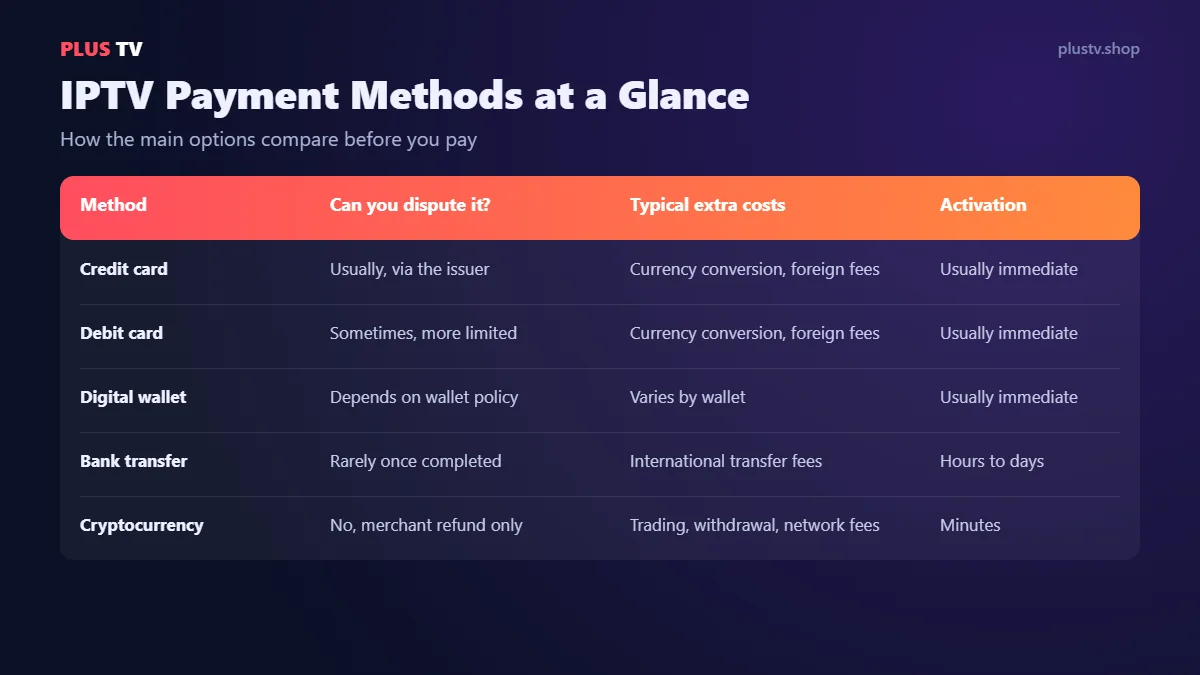
There is no single best method. The right choice depends on which of these factors matters most to you, and on which methods a particular checkout actually supports.
Credit cards
Credit cards are the most familiar way to pay online. Their main advantage for subscriptions is that, in many countries, the card issuer offers a formal process for disputing a charge, sometimes called a chargeback. If you pay for a service that is never delivered or is materially different from what was described, you can ask your issuer to investigate. Time limits and conditions apply, and the outcome is not guaranteed, but having that route available is a meaningful safeguard. In the US, the FTC explains how disputing credit card charges works.
The costs are usually indirect. If the provider charges in a different currency, your card may add a foreign transaction fee and apply its own exchange rate. Some checkouts also offer to convert the price into your home currency at the point of sale, which can be more expensive than letting your card issuer do the conversion. Read the final amount carefully before confirming.
Credit cards also make automatic renewal easy. That is convenient if you want uninterrupted service, but it means you need to remember to cancel if you no longer want the subscription. Note the renewal date when you sign up.
Debit cards
A debit card looks the same as a credit card at checkout, but the money leaves your bank account immediately. Dispute rights for debit transactions exist in many places but are often more limited, and getting money back can take longer because the funds have already left your account rather than sitting on a credit balance.
Debit cards share the currency and renewal considerations of credit cards. If you prefer to use one, consider a separate account or a card with a spending limit for online subscriptions, so a problem with one merchant does not affect your main account.
Prepaid and virtual cards are a useful middle ground. Many banks and card providers let you create a card number for a single merchant or set a monthly limit, which keeps your main card details private and stops unexpected renewals from exceeding a set amount. Check whether your bank offers this before you subscribe.
Digital wallets and payment apps
Digital wallets and payment apps let you pay without typing card details into the merchant’s site, which reduces how many places store your card number. Some offer their own buyer-protection programmes, but coverage varies widely and some exclude certain types of digital services or subscriptions. Read the wallet’s protection policy rather than assuming it applies.
Availability is the main limitation. Not every IPTV checkout supports every wallet, and a wallet funded by a linked card or bank account still inherits some of that underlying method’s rules. Check the checkout options before you decide on this route.
Bank transfers
A direct bank transfer can be inexpensive for domestic payments, but international transfers often carry fees and take longer to arrive, which can delay activation. More importantly, a completed transfer is generally hard to reverse. If you send money to the wrong account, or to a fraudulent one, recovery depends largely on the cooperation of the receiving bank.
Be especially careful when bank details arrive by chat or email rather than appearing at an official checkout. Payment-redirection scams, where a criminal sends “updated” account details, are common across many industries. Verify any change through an independent, official channel before paying.
Cryptocurrency
Many IPTV providers accept cryptocurrency, and for customers who already hold digital assets it can be quick and convenient, particularly across borders. The trade-offs are significant, though. Blockchain transfers generally cannot be reversed once confirmed, so there is no card-style dispute process. Any refund depends entirely on the merchant’s own policy and goodwill.
Costs depend on the network and on your exchange or wallet. You may pay a trading fee to buy the coin, a withdrawal fee to send it and a network fee for the transfer itself. Volatile coins such as Bitcoin can also change in value between the moment you buy and the moment you pay. Contrary to a common belief, crypto is not automatically anonymous: public blockchains record transfers, and most exchanges verify their customers’ identities.
Stablecoins, such as USDT and USDC, are designed to track the US dollar, which removes most of the price volatility. They still require you to choose the correct blockchain network and address, and a transfer on the wrong network can be difficult or impossible to recover. If you plan to pay this way, our guides to buying IPTV with crypto and paying safely with cryptocurrency walk through the checks in detail. The US Federal Trade Commission’s overview of cryptocurrency and scams is also worth reading first.
Compare the true total cost
The subscription price is only part of what you pay. To compare IPTV payment methods fairly, add up every fee that applies to your situation. The example below is illustrative: the fee levels are assumptions chosen to show how the maths works, not quotes from any card issuer, exchange or network.
| Illustrative scenario | Subscription | Assumed fees | Total paid |
|---|---|---|---|
| Card, same currency | $39.99 | None | $39.99 |
| Card, foreign currency | $39.99 | 3% foreign transaction fee | about $41.19 |
| Stablecoin from an exchange | $39.99 | $1.00 withdrawal fee | $40.99 |
| Bitcoin bought for the purchase | $39.99 | 0.5% trading fee + $2.00 network fee | about $42.19 |
In this example the differences are small in absolute terms, but they add up over several renewals, and they can be larger for international transfers or busy blockchain networks. Check the actual fees shown by your card issuer, bank or exchange before you choose, and compare them with the protections each method offers. Saving a dollar is rarely worth giving up the ability to dispute a charge on a long plan.
Protection versus convenience
The clearest dividing line between payment methods is reversibility. Card payments, and some wallet payments, sit inside systems designed to handle disputes. Bank transfers and cryptocurrency mostly do not. That does not make reversible methods automatically better, but it changes where your protection comes from.
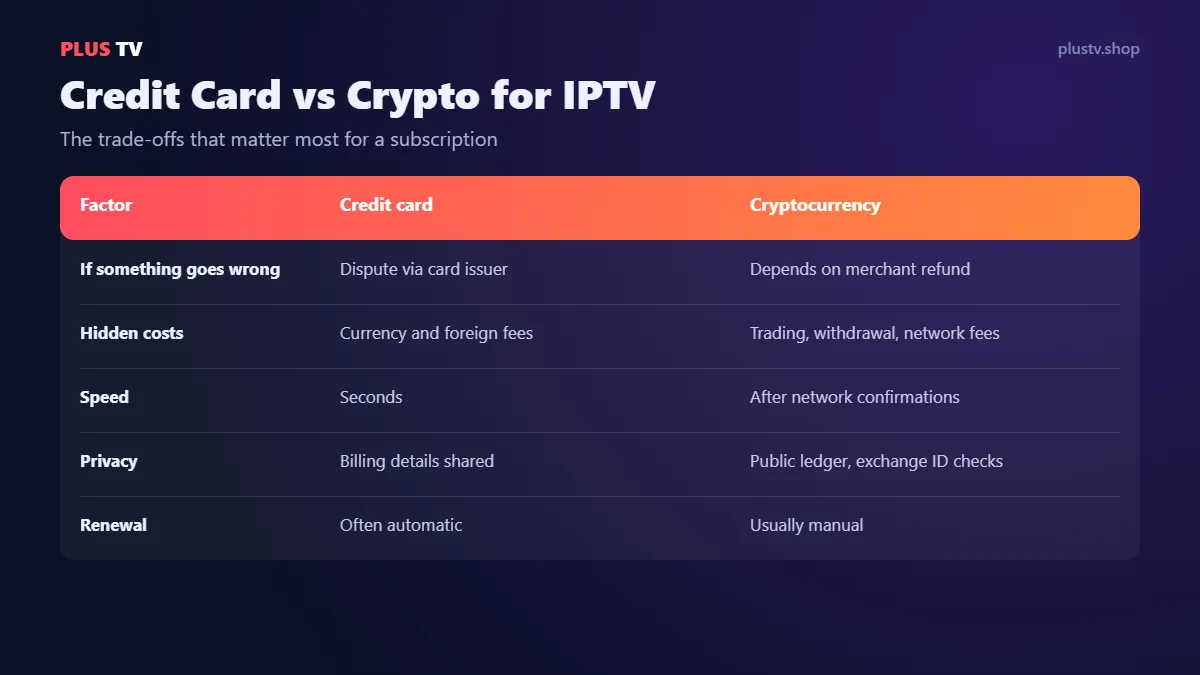
With a card, part of your protection is the dispute process. With an irreversible method, almost all of your protection comes from choosing a trustworthy provider and reading its policies. Before using crypto or a bank transfer, read the refund and returns policy and the terms of service, and keep copies of your order, invoice and any written promises.
Speed of activation
Card and wallet payments are usually authorised within seconds, so activation can often begin straight away. Cryptocurrency payments depend on network confirmations and on how quickly the merchant matches the transfer to your order, which can take anywhere from a few minutes to longer during busy periods. Bank transfers, especially international ones, can take one or more working days.
If you need access for a specific event, such as a live match, choose a method that clears quickly and pay well in advance. Whatever you use, keep the order number and payment reference so support can find your payment quickly if activation is delayed.
Privacy and personal data
Every payment method shares some information. Cards and wallets pass your name and billing details to a payment processor; bank transfers reveal account details; crypto transfers are recorded on a public ledger and often linked to an exchange account that holds your identity. The practical question is how much you share with the merchant directly.
Wallets and hosted card checkouts can reduce what the merchant itself stores. Read the provider’s privacy policy to understand what is collected and why. Never send card numbers, passwords, one-time codes or wallet recovery phrases by chat or email, whichever method you choose.
Automatic renewals and recurring payments
Cards and many wallets support recurring billing, so a subscription can renew automatically. That avoids interruptions, but it also means you can be charged for a period you no longer want if you forget to cancel. The FTC’s guidance on free trials and auto-renewals explains what to look for before you agree to recurring charges.
Crypto and bank transfers are normally one-off payments, so you renew manually. That gives you a natural checkpoint to reconsider the service, but it also means service can lapse if you miss the renewal date. Whichever applies, put the renewal date in your calendar.
Which payment method suits you?
- You want the strongest fallback if something goes wrong: a credit card, where accepted, usually offers the most established dispute route.
- You want to share fewer card details with merchants: a digital wallet or a hosted checkout can help.
- You already hold stablecoins and pay across borders: crypto can be convenient, provided you are comfortable with networks, fees and irreversibility.
- You are new to crypto: avoid buying it solely for one subscription; the learning curve and fees may outweigh any benefit.
- You want to avoid accidental renewals: a one-off payment method, or a card with renewal reminders set, keeps you in control.
How to pay safely, whichever method you use
The habits that protect you are largely the same across every payment method:
- Start from the provider’s official website and checkout, not a link sent by message.
- Confirm the plan, duration and currency before entering any payment details.
- Read the refund and cancellation terms, especially for irreversible methods.
- Check the final amount, including any conversion or network fees, on the last screen.
- Save the order confirmation, invoice and payment reference or transaction hash.
- Note the renewal date and how to cancel if the plan renews automatically.
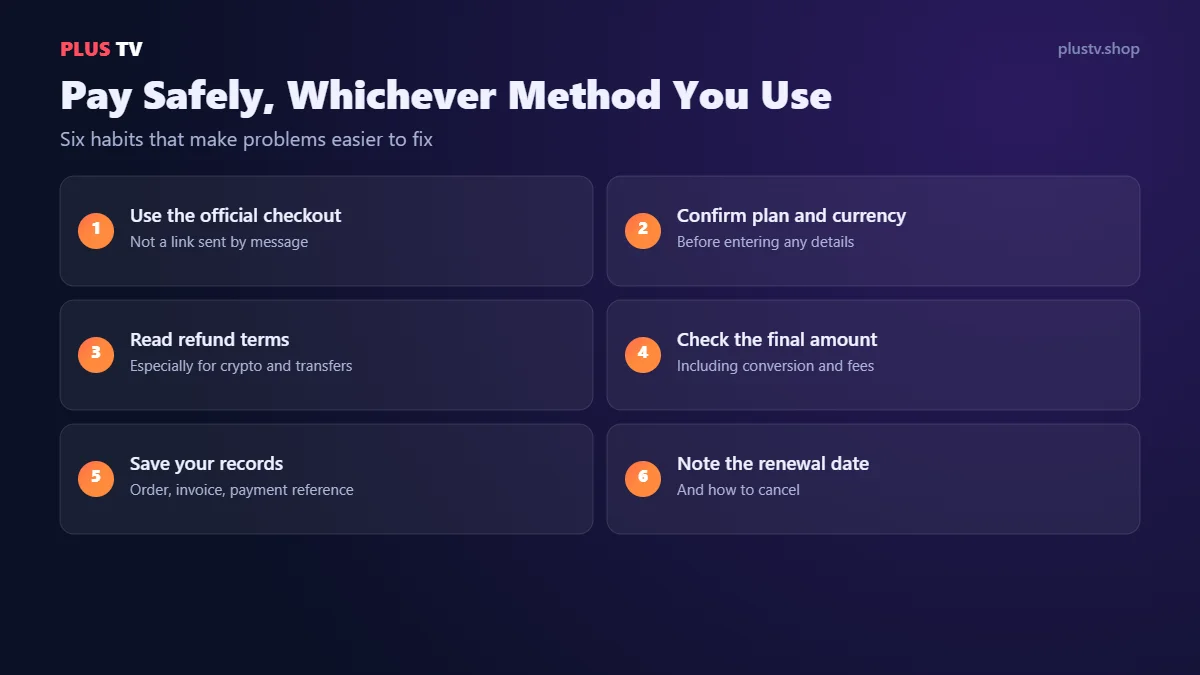
These steps take a couple of minutes and make it much easier to resolve problems, whether that means a card dispute, a support ticket or simply proving that you paid.
Payment red flags to watch for
- Payment details that arrive by chat, email or social media rather than at an official checkout.
- A seller insisting on one irreversible method and refusing any alternative without a clear reason.
- Requests for card numbers, passwords, verification codes or wallet recovery phrases.
- Pressure to pay immediately before you have read the terms or tested the service.
- Prices that change in the final step, or extra fees that were never mentioned.
Any one of these is a reason to pause. Several together are a reason to walk away.
What to do if a payment goes wrong
If you have paid but the subscription has not been activated, contact the provider’s support first through an official channel, with your order number and payment reference. Many problems are simple mismatches, such as a payment that arrived slightly short because of fees, and are resolved quickly.
If the provider does not respond or refuses to deliver what you paid for, your options depend on the method. For card payments, contact your card issuer promptly, because dispute windows are time-limited. For wallets, check the wallet’s own resolution process. For bank transfers and cryptocurrency, contact your bank or exchange straight away, but be aware that recovery is often not possible. If you suspect fraud, report it to the relevant authority in your country as well.
Frequently asked questions
What are the most common IPTV payment methods?
Credit and debit cards, digital wallets, bank transfers and cryptocurrency, including stablecoins such as USDT and USDC. Which ones are available depends on the provider’s checkout.
Is it safer to pay for IPTV by card or crypto?
They protect you in different ways. Cards often come with a dispute process through the issuer, while crypto transfers generally cannot be reversed. With crypto, your protection depends mainly on the provider’s reputation and refund policy.
Can I get a refund if I paid for IPTV with crypto?
Only if the merchant agrees under its refund policy. Blockchain transfers cannot be reversed by your bank or wallet, so read the policy before paying.
Why was my card charged more than the listed price?
Usually because of currency conversion or a foreign transaction fee added by your card issuer. Check the currency at checkout and your card’s fee terms.
Is paying for IPTV with crypto anonymous?
Not necessarily. Public blockchains record transfers and most exchanges verify customer identities. Treat crypto as a payment method, not a privacy guarantee.
Should I use a payment method with automatic renewal?
It avoids interruptions but can lead to unwanted charges if you forget to cancel. If you choose it, note the renewal date and check how to cancel.
The bottom line
Choosing between IPTV payment methods is a trade-off between protection, cost, speed and privacy. Cards usually offer the strongest dispute route; crypto and bank transfers trade that for other benefits but are hard to reverse. Whatever you choose, pay only through the official checkout, add up the full cost, read the refund policy and keep your records. That habit protects you far more than any single payment method.
Related Articles

November 20, 2026
IPTV in Kosovo, Serbia and North Macedonia: Language and Device Compatibility Guide

November 20, 2026
IPTV in the Balkans: A Regional Viewing Guide for Families and Diaspora

November 20, 2026
IPTV in Albania: Devices, Albanian Language and Setup Guide

November 20, 2026