
🔥 FLEXIBLE & SECURE PAYMENTS — USDT • USDC • BTC • ETH • SOL • TRON (TRC20) • BINANCE PAY • KAST & MORE
How IPTV Reseller Panels and Credits Work
How IPTV reseller credits work: what a reseller panel does, how credits convert into subscriptions, trials, renewals, multi-screen plans, sub-resellers and honest cost planning.
 plustv
•
13 min read
If you are thinking about reselling IPTV subscriptions, the first unfamiliar idea you will meet is the credit. Suppliers rarely sell resellers individual subscriptions; instead, they sell blocks of credits that you spend inside a control panel to create and renew customer accounts. Understanding how IPTV reseller credits work, what they cost and how quickly they are used up is essential before you spend money on a panel.
This guide explains the mechanics in plain language: what a reseller panel is, how credits convert into subscriptions, how trials, renewals and multi-screen plans affect your balance, and how to plan your costs. It does not promise profits. Results depend on your supplier, your customers, your support and the laws where you operate. If you want a broader view of running a reseller business, our reseller program guide covers support and planning in more depth.
Table of Contents
IPTV reseller credits in 60 seconds
- A reseller panel is a web dashboard where you create and manage customer accounts.
- Credits are the panel’s currency. You buy them from your supplier in advance.
- Creating or renewing a customer account uses credits, usually according to the length of the subscription.
- A common pattern is one credit per month of service, but conversion rates vary by supplier.
- Multi-screen plans, add-ons or special packages may use more credits.
- Trials are often free or cheap in credits but may be limited in number.
- Your margin is the difference between what you charge customers and the cost of the credits used, minus your other costs.
What is an IPTV reseller panel?
A reseller panel is the control centre of a reseller business. It is usually a web page you sign in to from a computer or phone. From there you can create new customer lines, set how long each subscription lasts, renew or extend existing customers, issue trials, see when subscriptions expire and, on some panels, manage sub-resellers who work under you.
The panel connects to your supplier’s service. When you create a line, the panel generates the login details or playlist link that your customer enters into their player app. You never handle the streams yourself; the panel simply manages access to the supplier’s service. That makes the supplier’s reliability, and its right to distribute the content it carries, central to your business.
Panels differ in features. Some show detailed usage and connection logs; others only list customers and expiry dates. Ask for a demo or screenshots before buying credits, so you know what you will be working with every day.
How credits work
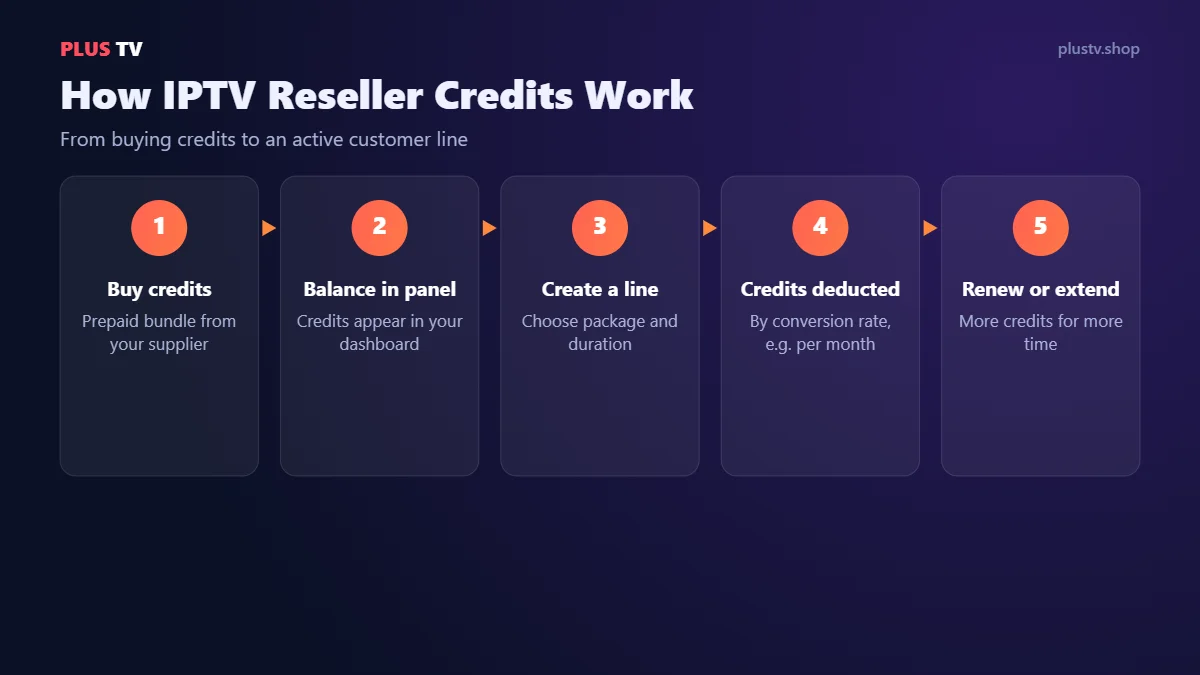
Credits are prepaid units of value. You buy a bundle from your supplier, and the bundle appears as a balance in your panel. Each time you create or renew a customer account, the panel deducts credits from that balance. When the balance reaches zero, you cannot create or renew accounts until you buy more.
The key detail is the conversion rate: how many credits each type of subscription costs. Many panels use a simple rule where one credit equals one month of a single-screen subscription, so a 12-month subscription costs 12 credits. Others offer discounted longer plans, for example charging fewer credits for a year than for twelve separate months. Some charge differently for different packages. Always get the conversion table in writing from your supplier before buying.
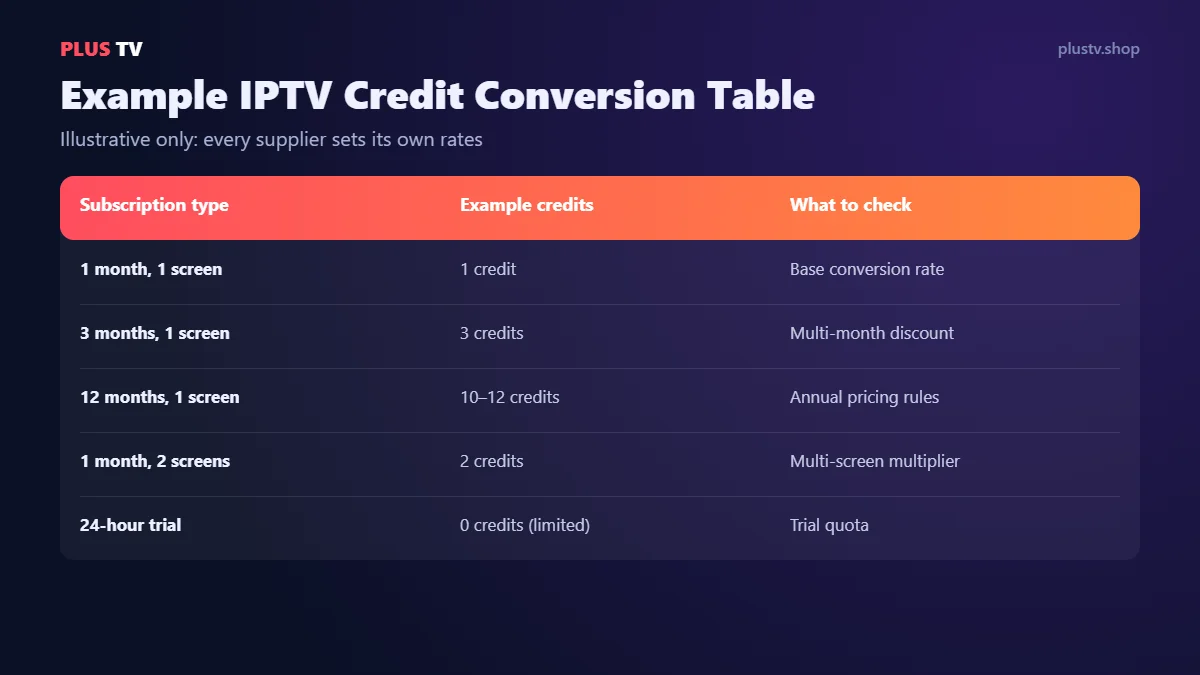
| Subscription type | Example credit cost | What to check |
|---|---|---|
| 1 month, 1 screen | 1 credit | Base conversion rate |
| 3 months, 1 screen | 3 credits | Any multi-month discount |
| 12 months, 1 screen | 10–12 credits | Annual pricing rules |
| 1 month, 2 screens | 2 credits | Multi-screen multiplier |
| 24-hour trial | 0 credits (limited) | Trial quota per period |
The table above is an illustrative example of a credit table, not any specific supplier’s pricing. Your supplier’s table may look quite different, which is exactly why you need to see it before you buy.
One practical tip: when you first receive the conversion table, create a small spreadsheet with each package, its credit cost and your selling price. Updating that one sheet whenever your supplier changes its rates keeps your quotes consistent and shows immediately if a change has squeezed your margin on a particular plan.
Buying credits: bundle sizes and pricing
Suppliers usually sell credits in bundles, and larger bundles typically cost less per credit. That makes big bundles tempting, but buying more than you can realistically use ties up money and increases your risk if the supplier changes its terms or stops operating.
Before choosing a bundle size, ask your supplier these questions:
- Do credits expire, and if so, after how long?
- Are credits refundable if the service is discontinued?
- Can the conversion rate change after you have bought credits?
- Which payment methods are accepted, and are payments reversible?
- Is there a minimum first purchase?
Many reseller panels are paid for in cryptocurrency. If that is the case, remember that blockchain payments are generally irreversible, so your protection depends on the supplier’s reputation and written terms. The FTC’s guide to cryptocurrency and scams lists warning signs that apply to business purchases too. Our article on reseller panels with crypto payments covers that side in more detail.
Creating, renewing and extending customer lines
Creating a customer line usually takes a minute. You choose a username or let the panel generate one, select the package and duration, and confirm. The panel deducts the matching credits and shows the login details or playlist link for your customer. Send these privately and remind customers not to share them.
Renewals work in a similar way. Most panels let you extend an existing line by a chosen duration, deducting credits again. Some panels add the new time to the current expiry date; others start from the renewal date. Check which rule your panel uses, because renewing early on a panel that resets from today could waste days your customer has already paid for.
Keep your own record of who paid what, for how long and when they expire, even if the panel shows expiry dates. Panels can change or go offline, and your records are what let you support customers and settle disagreements.
Finally, set a regular day each week to review your balance, upcoming expiries and any customers who have not renewed. Fifteen minutes of routine prevents most surprises.
Trials and how they affect your balance
Trials let potential customers test the service before paying. Many panels offer short trials, often 24 to 48 hours, either free or for a fraction of a credit. Suppliers frequently limit how many trials you can create, to prevent abuse.
Trials are valuable, but they are not free in practice. Each one takes your time to set up and support, and some suppliers count them against a quota. Track how many trials turn into paying customers. If very few do, the problem might be the service, the setup instructions you give, or the type of customer you are attracting. Give every trial user clear setup steps, such as your supplier’s installation tutorial, so the trial reflects the service rather than setup confusion.
Multi-screen plans and add-ons
Customers often want to watch on more than one TV at the same time. Panels usually handle this with multi-connection packages, which cost more credits. A two-screen month might cost two credits instead of one, for example, though the exact multiplier depends on your supplier.
Price multi-screen plans carefully. Because they use more credits, a discount that looks generous to the customer can wipe out your margin. Some panels also offer add-ons, such as extra content packages, that change the credit cost. Make sure you understand every option before quoting a price to a customer.
Sub-resellers
Some panels let you create sub-reseller accounts. You transfer part of your credit balance to a sub-reseller, who then creates and manages their own customers. This can extend your reach, but it also means you are responsible for people whose support quality and conduct you do not fully control.
If you use sub-resellers, agree in writing how credits are priced, who handles customer support and what happens if a sub-reseller breaks the rules. Check whether your supplier allows sub-resellers at all, and whether transferred credits can be reclaimed.
Managing your credit balance
Think of credits like stock in a shop. Run out, and you cannot serve customers; buy far too many, and money sits idle. A little planning keeps the balance healthy without tying up more than you need.
Start by tracking how many credits you use each month, split into new customers and renewals. After a few months, you will see a pattern. Set a reorder point, for example enough credits to cover two weeks of typical renewals, and buy more when you reach it rather than waiting until the balance hits zero.
Look ahead at expiry dates too. Most panels let you sort or export customers by expiry. If twenty annual subscriptions renew in the same month, you will need many more credits that month than usual. Planning for these peaks avoids last-minute purchases at a time when your supplier might be slow to respond.
Planning costs and margins
Your margin is the difference between what a customer pays you and the cost of the credits their subscription uses, minus every other cost: payment fees, refunds, support time, advertising and any tools you pay for. A simple example shows how quickly these add up.
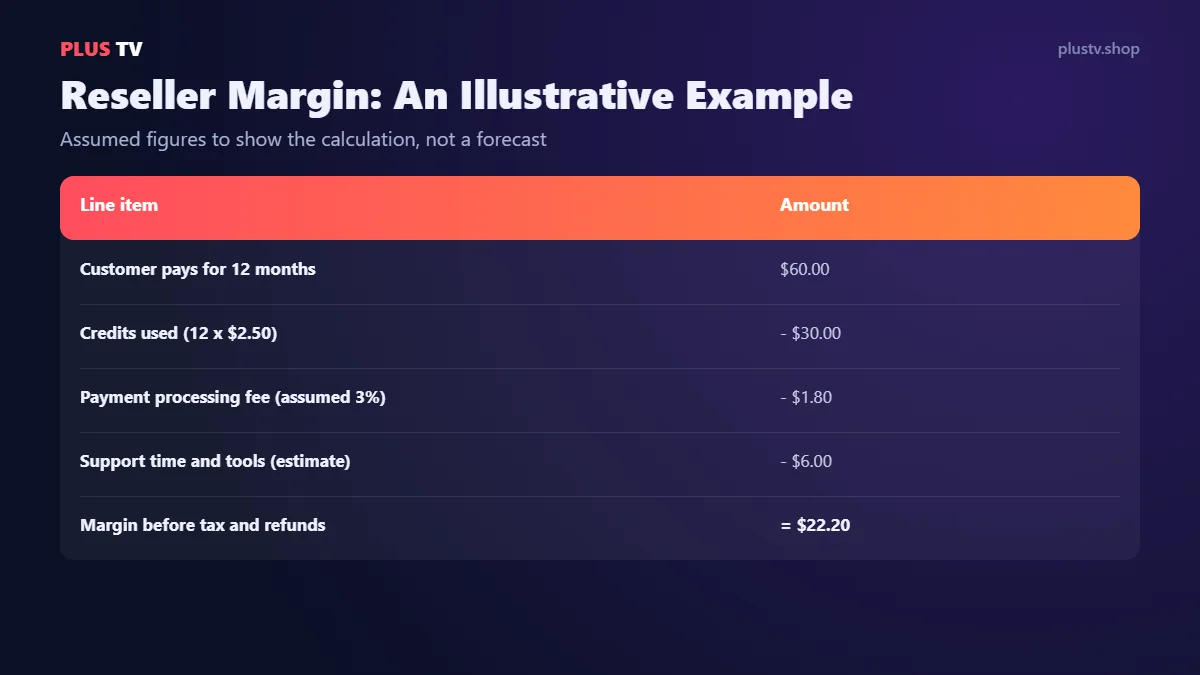
| Illustrative line item | Amount |
|---|---|
| Customer pays for 12 months | $60.00 |
| Credits used (12 × $2.50) | −$30.00 |
| Payment processing fee (assumed 3%) | −$1.80 |
| Support time and tools (estimate) | −$6.00 |
| Margin before tax and refunds | $22.20 |
The figures are illustrative, chosen only to show the calculation. In practice, refunds, unpaid renewals and support time can reduce margins considerably, which is why no honest supplier can promise a particular profit. Run the numbers with your own costs before committing money, and be wary of anyone who shows only the best-case column. For more on keeping customers over time, see our article on building a reseller business.
Supporting customers efficiently
Support is where resellers win or lose customers. Most questions are predictable: how to install the app, how to enter login details, why a channel is not working and when a subscription expires. Preparing for them saves hours every week.
- Write a setup message template with the login details, a link to the installation guide and the expiry date, and send it with every new line.
- Send renewal reminders a few days before expiry, so customers are not cut off unexpectedly in the middle of a match.
- Keep short answers ready for the most common problems, such as restarting the app, checking the internet connection and re-entering login details.
- Collect useful details when something goes wrong: device, app, channel, time and error message. Pass them to your supplier if the problem is on their side.
Customers judge you on how quickly and clearly you respond, not just on the service itself. A reseller who answers well often keeps customers through the occasional outage.
Choosing a supplier and panel
Because your customers rely entirely on your supplier’s service, choosing a supplier is the most important decision you make. Look for clear answers to these questions:
- Is the supplier authorised to distribute the content it offers in the countries where you will sell?
- Can you see the panel and the credit conversion table before buying?
- How does the supplier handle outages, and how will you be informed?
- What support does the supplier give resellers, and how quickly?
- Are the terms, refund rules and credit expiry written down?
Test the service yourself, on several devices, before you sell it to anyone. If you cannot recommend it to a friend, you will struggle to support paying customers. You can find more about the Plus TV approach on our reseller page.
Common mistakes with reseller credits
- Buying the biggest bundle first. Start smaller until you trust the supplier and know your monthly usage.
- Not checking the renewal rule. Renewing early on a panel that resets from today can waste credits.
- Underpricing multi-screen plans. Extra connections use extra credits; price them accordingly.
- Giving away too many trials. Track conversions and focus trials on genuinely interested customers.
- Relying only on the panel’s records. Keep your own list of customers, payments and expiry dates.
Legal and ethical responsibilities
Reselling IPTV is only legitimate when the underlying service has the rights to distribute its content in the territories where you sell. Selling access to content without those rights can be illegal in many countries and can expose you, not just your supplier, to legal risk. Ask your supplier about its rights and keep their answers on file.
Treat customers fairly too. Be clear about what the service includes and what it does not, publish your own refund and support terms, protect customer data and never promise uninterrupted service. Honest descriptions lead to fewer refunds and more renewals than exaggerated ones.
Frequently asked questions
What are IPTV reseller credits?
Credits are prepaid units you buy from a supplier and spend inside a reseller panel to create or renew customer subscriptions. The number of credits each subscription uses depends on its length and package.
How many credits does a one-month subscription use?
Many panels use one credit per month for a single screen, but this varies by supplier. Always ask for the full credit conversion table before buying.
Do IPTV reseller credits expire?
Some do and some do not. Expiry rules are set by the supplier, so confirm them in writing before buying a large bundle.
Do trials use credits?
Often they are free or very cheap in credits but limited in number. Check your supplier’s trial quota and rules.
Can I give credits to a sub-reseller?
Many panels allow you to transfer credits to sub-reseller accounts, but not all suppliers permit it. Agree pricing and support responsibilities in writing first.
Is reselling IPTV legal?
It depends on whether the underlying service has the rights to distribute its content where you sell. Reselling unlicensed content can be illegal in many countries, so verify your supplier’s rights.
Final thoughts
Once you understand how IPTV reseller credits work, a panel stops being a mystery: you buy credits in advance, spend them to create and renew customer lines, and manage your balance like stock. The details that decide whether it works for you are the conversion rate, credit expiry, multi-screen pricing, trial limits and, above all, the supplier’s reliability and rights. Get those answers in writing, test the service yourself and run the numbers honestly before you buy your first bundle.
Related Articles

November 20, 2026
IPTV in Kosovo, Serbia and North Macedonia: Language and Device Compatibility Guide

November 20, 2026
IPTV in the Balkans: A Regional Viewing Guide for Families and Diaspora

November 20, 2026
IPTV in Albania: Devices, Albanian Language and Setup Guide

November 20, 2026